A commercial maintenance programme must cover more than a yearly visual inspection: it needs defined assets, scheduled tasks, measured test results, safe isolation and a process for correcting defects. By the end, you will be able to specify the maintenance scope, judge whether a provider’s records are adequate and compare contract terms before signing.
Key takeaways
- Define every asset, interface and exclusion in writing.
- Match inspections and tests to equipment risk and manufacturer instructions.
- Use isolation, lockout-tagout and documented permit controls before work.
- Rank defects by immediate danger, service impact and repair urgency.
What equipment belongs in the maintenance scope?
Define asset boundary before scheduling work. The commercial electrical maintenance scope starts with a written list of assets and interfaces, not a promise that everything on the premises is covered.
Include distribution boards, switchgear, busbars, circuit breakers, transformers and generators, automatic transfer switches, UPS systems, batteries, earthing conductors and earth pits, lightning protection, emergency lighting, power-factor-correction capacitor banks, fixed wiring, sockets, isolators and controls.
1. Mark each asset with its location, identifier, supply source and responsible party. State whether portable appliances, extension leads, lifts, fire systems, machinery control panels, data-centre power paths, tenant equipment and battery chargers are included or managed under separate statutory, manufacturer or operational regimes.
2. Set intervals from equipment criticality, loading, age, operating environment, manufacturer instructions, failure consequences, previous defects and maintenance history. Do not give every asset one annual visit; a heavily loaded, ageing transformer needs a different plan from a lightly used socket.
3. Test generators and UPS systems under representative load. Identify whether that means site load, a load bank or both, then record voltage, frequency, transfer performance and run duration; no-load starting misses transfer faults, weak batteries and overheating.
4. Separate a brief emergency-lighting function test from a full rated-duration battery test. Stagger duration tests and maintain controls so simultaneous testing does not remove building coverage.
Which maintenance tasks belong on each schedule?
Build the preventive maintenance schedule around equipment criticality, loading, operating environment, age, manufacturer instructions, previous defects and failure consequences. Daily electrical checks identify changing conditions; annual electrical testing provides deeper evidence, but neither replaces the other.
| Schedule | Tasks | Record or response |
|---|---|---|
| Daily | Check alarms, abnormal smells or noise, visible damage, water ingress, room temperature, ventilation, generator or UPS status and repeated breaker trips. | Log readings and isolate unsafe equipment. |
| Monthly | Inspect panels, sockets, emergency-light operation, battery condition, housekeeping, capacitor-bank alarms and accessible earthing or lightning-protection components. | Raise defects with an asset reference. |
| Quarterly | Perform a quarterly inspection using thermal scanning on loaded terminations and busbars, RCD instrument testing where required, generator or UPS transfer and load testing, and trend-data review. | Compare results with baseline values. |
| Half-yearly | Examine cable terminations, enclosure seals, earth-pit condition, lightning conductors, battery-capacity indicators and protective-device settings against approved records. | Investigate deterioration or unauthorised changes. |
| Annual | Complete planned shutdown inspections, manufacturer-specified torque checks, insulation-resistance tests on suitable isolated circuits, earth-continuity and earth-pit resistance measurements, full emergency-light duration testing and a formal single-line-diagram review. | Correct defects before re-energising. |
Change any interval when condition, duty cycle or failure risk justifies it. A critical, heavily loaded board needs closer attention than a lightly used, clean enclosure.
How should electrical equipment be inspected and tested?
Demand measured evidence, not a tick-box “passed” result. Each record should identify the asset, test method, instrument, calibration status, readings, operating conditions and defects found.
- Perform a thermal imaging electrical inspection on loaded switchboards, cable terminations, busbars and protective devices. Record load current, ambient conditions, and any reflection or emissivity limitation; a low-load scan can miss heating that appears near operating load.
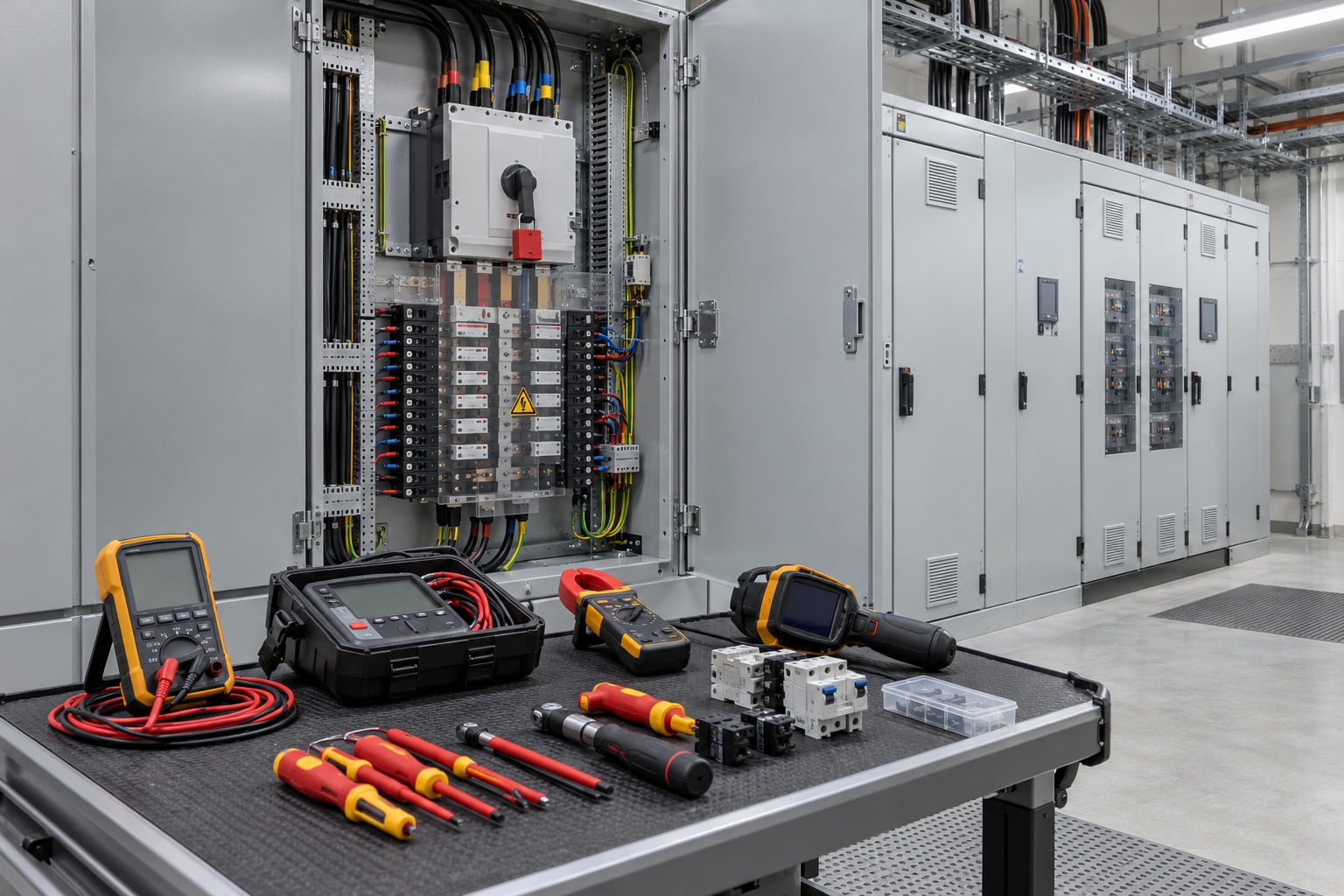
- Carry out insulation resistance testing with a calibrated megohmmeter only after dividing circuits. Disconnect VFDs, LED drivers, surge-protective devices, meters and other electronics where manufacturer instructions require it, or the test voltage can damage components.
- Verify earth continuity and measure earth-pit resistance. Record the method, test leads, instrument identification and measured result.
- Include RCD trip testing when the installation standard, device type and risk assessment require it. Record measured trip current and trip time; the built-in test button is not equivalent.
- Check busbar and cable-connection torque against the manufacturer’s specification using a calibrated torque tool. Do not blanket-retighten connections: over-torquing damages terminals, while under-torquing causes contact resistance and heat.
- After major changes, recalculate fault current, selectivity, earth-fault-loop performance and arc-flash energy. A visual inspection will not reveal invalidated protection assumptions.
What safety controls must govern maintenance work?
Classify the task before anyone opens an enclosure. Work that could expose a person to live conductors requires an authorised electrician, an approved method statement and, where site rules require it, a permit to work electrical.
1. Identify every supply, including backfeeds, generators, UPS systems, control circuits and stored energy. Open a breaker alone is not electrical isolation.
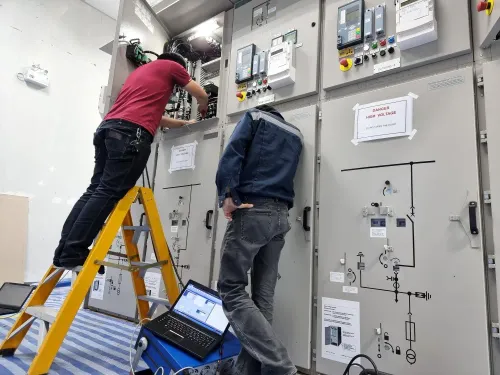
2. Isolate each source, apply lockout tagout, discharge capacitors and other stored energy, then verify absence of voltage with an adequately rated tester. Prove the instrument on a known live source before testing and again afterward.
3. Coordinate shutdowns with tenants, security, fire-system operators, building operations and critical-process owners. Record restoration checks and name the person permitted to re-energise.
4. Use an energised-work procedure only when the risk assessment justifies it and site rules authorise it. Stop immediately for exposed live parts, nearby water ingress, fire hazards, lost protective earthing or equipment that cannot be safely isolated.
Do not blow dust through an energised switchboard. Investigate moisture, conductive dust, salt, chemical vapour, vermin and blocked ventilation; repair seals, filtration, dehumidification or other environmental controls before returning equipment to service.
What records and defect priorities should you demand?
Demand electrical maintenance records that make every visit traceable, not a “passed” tick. Preserve baseline readings so gradual deterioration appears before a limit is exceeded.
1. Check that the file includes an asset register, current single-line diagram, inspection checklist, circuit or equipment identifier, test method, measured readings, loading, environmental conditions, instrument serial number, calibration status, defect photographs, defect risk ranking, corrective action log and completion sign-off.
2. Rank exposed live parts, overheating terminations, insulation failure, water ingress and loss of protective earthing as immediate or high-risk defects. Investigate repeated breaker trips and nuisance RCD operation instead of repeatedly resetting them.
3. For every defect, record the affected asset, evidence, consequence, compensating control, responsible party, due date and condition left after work. Separate immediate danger from a non-urgent recommendation; “monitor”, “repair” and “replace” are incomplete without a circuit, reason and deadline.
State whether the equipment remains safely in service, has been isolated or needs an urgent shutdown.
4. Complete a post-change review after replacing a protective device, transformer, generator, UPS, cable route or major load. Recheck protection settings, coordination, fault-current assumptions and affected test results.
How should you choose the maintenance model and contract?
Match the service model to the risk, not to a standard annual visit. Preventive maintenance follows planned intervals; corrective maintenance repairs a known defect; predictive maintenance uses trends such as thermal readings, insulation values, battery performance and load data; emergency call-out service responds to failures or hazards.
| Model | What it does | When it applies |
|---|---|---|
| Preventive | Planned inspection and testing | Routine assets with defined intervals |
| Corrective | Repairs a recorded defect | After an identified failure or deterioration |
| Predictive | Tracks condition trends | Critical assets where early warning matters |
| Emergency | Responds to breakdowns or hazards | Loss of supply, fire risk or unsafe equipment |
A strong electrical maintenance contract combines all four and names the included assets, visit frequency, response time, exclusions, consumables, spare parts, testing scope, calibration requirements, shutdown planning, after-hours rates and escalation route. Confirm whether generator and UPS tests use site load, a load bank or both, and whether emergency-light duration tests are included.
Ask the facility electrical maintenance provider who coordinates tenants, obtains permits, updates drawings and signs off restoration. Navyashree Engineers Private Limited can be assessed against evidence rather than manpower promises: request sample checklists, test certificates, calibrated-instrument details, defect photographs and a corrective-action workflow. Name the authorised decision-maker who can isolate unsafe equipment.
Related product
 | Facility Management Services Navyashree Engineers. provides Facility Management Services to a large number of Corporates backed by Skilled & Technical manpower. View product → |
Frequently asked questions
What equipment belongs in a commercial electrical maintenance scope?
List each HT and LT switchboard, transformer, generator, UPS, distribution board, cable route, protection device, earthing system, lighting system and electrical interface with HVAC or facility equipment. Record asset IDs, locations, ownership and exclusions.
Which maintenance tasks belong on each schedule?
Use daily or shift checks for alarms, temperature, noise, smell and visible damage; monthly or quarterly checks for cleaning, tightening and functional operation; and planned annual testing for protection, insulation, earthing and other condition-dependent systems.
How should commercial electrical equipment be inspected and tested?
Inspect labels, enclosures, terminations, ventilation, cable condition and signs of overheating. Test only with suitable calibrated instruments, following manufacturer instructions, safe isolation procedures and applicable electrical standards.
What safety controls must govern electrical maintenance work?
Use a risk assessment, method statement, permit-to-work, isolation, lockout-tagout, prove-dead testing, barriers, warning signs and suitable personal protective equipment. Authorise competent workers for the task.
What records and defect priorities should you demand?
Demand asset registers, inspection forms, test results, instrument calibration details, photographs, permits, work orders and closure evidence. Escalate exposed live parts, overheating, failed protection and dangerous earthing before lower-risk defects.