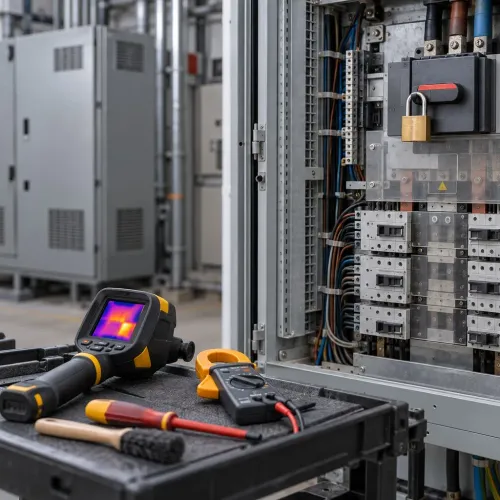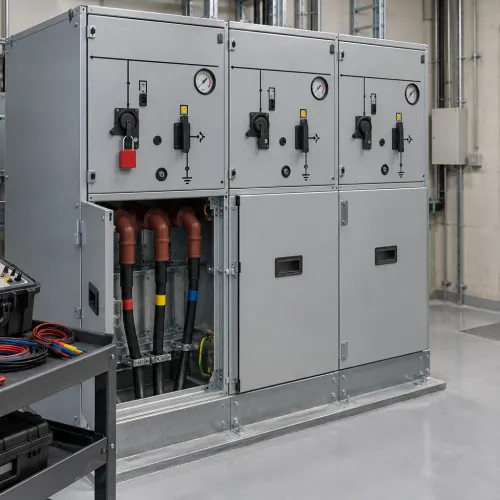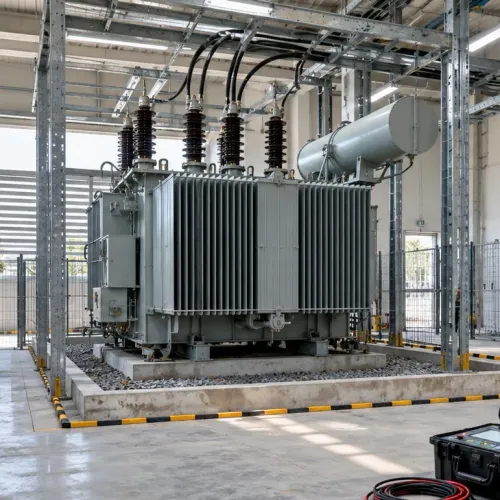
A transformer can be correctly sized in kVA and still fail the project because of starting current, harmonics, heat, fault duty, poor access or an unsuitable neutral arrangement. Before you approve a purchase, you need to translate the facility’s load, site conditions and protection requirements into a defensible specification, then verify that the quotation and installation documents match it.
Key takeaways
- Size the transformer from coincident maximum demand, not total nameplate load.
- Choose dry-type or oil-filled equipment according to fire risk, space and maintenance access.
- Specify voltage, impedance, vector group, taps, insulation level and protection before requesting quotes.
- Confirm foundations, clearances, earthing, cables, lifting access and testing responsibilities in writing.
How much transformer capacity does the facility actually need?
Calculate the required rating from coincident maximum demand, not by adding every nameplate value. Convert each load to kVA using kW ÷ power factor, apply operating schedules and demand factors, then divide the sum of noncoincident demands by the diversity factor. If you already have a measured facility maximum demand, do not divide it again.
- Record the connected load by category: lighting, HVAC, motors, lifts, UPS systems and process equipment.
- Establish maximum demand from interval data, load studies or credible operating schedules.
- Complete a starting current calculation for the largest motors, chillers and compressors. Check the resulting voltage dip at the transformer secondary, not only the running kVA.
- Add a documented allowance for named future equipment, spare capacity and harmonic-producing loads. Do not use an unexplained percentage to justify oversizing.
Transformer impedance controls the trade-off. Lower impedance reduces voltage sag during motor starting but increases available fault current; higher impedance limits fault current but can cause unacceptable starting dips. Include the selected impedance in both voltage-drop and short-circuit studies.
Rectifiers, variable-frequency drives and UPS systems can overheat a transformer despite adequate kVA. Check harmonic current, neutral loading and whether a K-factor design is needed; it handles thermal stress but does not remove harmonics or correct poor power factor.
Finally, verify nameplate voltage, phase, frequency and tap position against the actual supply. Off-circuit taps require de-energization, and the wrong tap can create secondary overvoltage or undervoltage.
Which transformer type and site location fit the project?
Choose an oil-immersed transformer for an outdoor substation or a dedicated, code-compliant transformer room when higher efficiency, compact outdoor construction and rugged service matter. Choose a dry-type transformer for indoor electrical rooms, high-rise buildings, hospitals, offices or production areas where liquid containment and spill exposure are unacceptable.
| Option | Best site fit | Main checks |
|---|---|---|
| Oil-immersed transformer | Outdoor yard or separated transformer room | Fire risk, fluid type, bunding, separation, drainage and inspection access |
| Dry-type transformer | Indoor room close to the load | Ventilation requirements, clearances, ambient temperature, dust, noise and heat rejection |
An oil-immersed transformer still needs fire and environmental controls. Mineral oil, less-flammable ester fluid and other liquids have different fire points, spill consequences and listing conditions; verify containment, fire barriers and the adopted electrical and fire codes before placing one indoors.
A dry-type transformer avoids liquid leakage, but it converts core and winding losses into room heat. Follow the manufacturer’s clearances and ventilation requirements, or thermal protection can trip and insulation life can fall even when the kVA load is acceptable. Check sound data and vibration isolation near offices, apartments, healthcare rooms and recording spaces.
Compare efficiency at the correct loading basis: low-voltage dry-type units use 35% rated load under U.S. Department of Energy evaluations, while medium-voltage dry-type and liquid-immersed distribution transformers use 50%. Also confirm access for delivery, maintenance, lifting and replacement before fixing the room or yard location.
Which electrical specification will keep the system stable and safe?
Match every nameplate value to the utility supply and facility load before energization; a correct kVA rating with the wrong electrical specification can create unstable voltage, nuisance trips or unsafe fault energy.
| Parameter | What to verify | Why it matters |
|---|---|---|
| Primary voltage | Actual utility line voltage and tap position | A wrong primary voltage can produce secondary overvoltage or undervoltage. |
| Secondary voltage | Required line-to-line and line-to-neutral voltage | Motors, drives and control equipment can fail or overheat outside their rated range. |
| Vector group | Required connection, such as Dyn11, and phase displacement | Paralleling incompatible transformers or feeding sensitive loads can cause circulating current or incorrect phase relationships. |
| Percentage impedance | Nameplate value for voltage-drop and short-circuit studies | Lower impedance improves motor starting but raises fault current; higher impedance limits faults but increases voltage sag. |
| Phase arrangement | Single-phase or three-phase, phase sequence and load balance | A three-phase transformer cannot correct a badly unbalanced downstream system. |
| Neutral | Whether the secondary needs a neutral, where it is bonded, and how the grounding electrode conductor is routed | Bond the derived-system neutral at the designated point only; duplicate bonds send neutral current through equipment grounding paths. |
| Frequency | Utility frequency, such as 50 Hz or 60 Hz | A frequency mismatch increases heating, magnetising current or motor speed errors. |
Off-circuit taps are not load-voltage controls. De-energize the transformer before changing them, and confirm the primary voltage first. Recheck breaker interrupting ratings, conductor ampacity, available fault current and arc-flash labels after any impedance, protection or bus change.
What must be ready before the transformer reaches the site?
Energization must wait until the site can support the transformer physically, electrically and safely. Complete these checks before delivery:
| Area | Ready condition | Failure if missed |
|---|---|---|
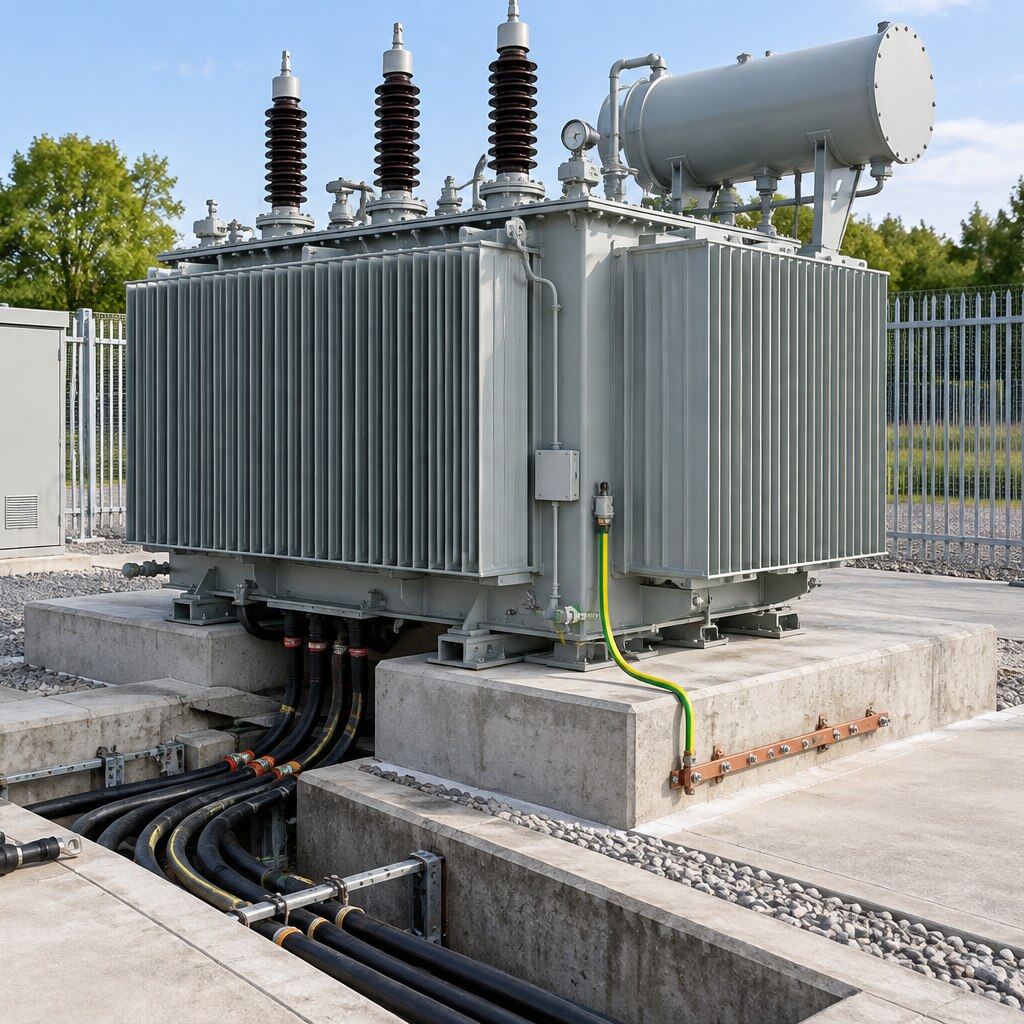
| Transformer plinth | Level, cured, load-rated and matched to the transformer base; provide oil containment for liquid-filled units | Settlement, misalignment or an uncontrolled spill |
| Access and lifting | Route, turning space, crane position and lifting capacity suit the transformer’s total shipping weight | The unit cannot be unloaded or moved without unsafe improvisation |
| Cable route | Cable trench is complete, drained, covered where required and sized for bending radius, separation and termination space | Cables are damaged, overheated or impossible to terminate |
| Room and fire provisions | Dry-type units have the manufacturer’s clearance and ventilation; liquid-filled units have required separation, spill control and fire protection | Heat damages insulation, or a fault spreads fire or contaminates soil |
| Protection | Primary and secondary devices have adequate continuous ratings, interrupting ratings for available fault current, inrush tolerance and coordination | Energization trips the breaker, or a fault exceeds the breaker’s capability |
Complete earthing and bonding before connecting conductors. Install the transformer tank bond, system bonding jumper, grounding electrode conductor and equipment grounding path exactly as designed; bond a separately derived neutral at the intended point only, or neutral current can flow on metalwork.
Before closing the primary breaker, verify the nameplate voltage, phase arrangement, frequency, vector group, impedance and tap position against the actual system. Test insulation resistance, winding resistance, turns ratio, polarity or phase sequence, protective-trip operation and, for liquid units, oil condition and leaks. Change an off-circuit tap only while de-energized.
How should you compare quotations, tests and installation responsibility?
A low quotation is not cheaper if it excludes testing, unloading, cable termination or protection coordination. Compare offers against one identical schedule: kVA, voltage ratio, vector group, impedance, tap range, enclosure, cooling method and guaranteed losses.
| Check | Ask for | Reject or clarify |
|---|---|---|
| Standards | Compliance with IS 1180 and applicable parts of IS 2026, plus the exact product specification | “As per standard” without naming the standard or edition |
| Losses | Guaranteed no-load and load losses at the stated test conditions, not only full-load efficiency | A kVA-only comparison that ignores lifetime energy cost |
| Factory evidence | Routine test report for the supplied unit and a type test report for the same design and ratings | Generic reports with different voltage, insulation level or construction |
| Guarantee | Written limits for losses, temperature rise, impedance, noise, workmanship and warranty remedy | Verbal promises or a warranty that excludes commissioning defects |
| Scope | Clear responsibility for transport, placement, oil filling, terminations, earthing, protection settings, testing and energisation | “Installation included” with no itemised boundary |
Require factory test values before delivery, then compare site results for insulation resistance, winding resistance, turns ratio, polarity, phase relationship and earth continuity. A single megohmmeter pass does not validate the transformer.
If Navyashree Engineers Private Limited is responsible for installation, place these duties in the purchase order and require marked-up drawings, test sheets and energisation approval before handover. Record the nameplate impedance: a change can invalidate short-circuit, arc-flash and PPE calculations even when the kVA stays unchanged.
Related products
 | HT Installation and Electrical Service HT Installation and Electrical Service Navyashree Engineers team does the installation, testing & commissioning of overhead HT/ LT transmission lines. View product → |
 | Electrical Design Consultants Navyashree Engineers provides high quality electrical system design & engineering capability, electrical project consultancy and construction... View product → |
Frequently asked questions
How do you calculate the transformer capacity a facility needs?
Convert each load to kVA using kW divided by power factor, apply operating schedules and demand factors, then account for diversity. Do not divide a measured facility maximum demand by the diversity factor again.
Which transformer type and location suit a project?
Compare dry-type and oil-filled transformers against fire risk, ventilation, noise, available space, maintenance access and the route for incoming and outgoing cables. Check clearances and lifting access before fixing the location.
Which specifications should a distribution transformer include?
State rated kVA, primary and secondary voltage, frequency, impedance, vector group, tap range, insulation level, cooling method, enclosure, losses, temperature rise and required protection.
What must be ready before delivery?
Complete the foundation, equipment room or plinth, cable trenches, earthing system, ventilation, fire provisions, access route, lifting plan and approved drawings before the transformer arrives.
How should transformer quotations be compared?
Compare the stated rating and specifications, guaranteed losses, routine and type tests, delivery scope, warranty, installation method, commissioning tests and each party's responsibility for cables, protection and energisation.
Related product
 | Licensed Class 1 Electrical Contractor Licensed Class 1 Electrical Contractor Navyashree Engineers is a leading class 1 licensed electrical contractors in Bangalore. View product → |